CJC-1295 With DAC Blog Package
Featured Product

CJC-1295 With DAC: Mechanism, Half-Life, and How It Compares to No-DAC and Other GHRH Analogs
Ask five different suppliers what makes CJC-1295 with DAC different from the No-DAC version, and you’ll often get five slightly different answers — usually something vague about “longer-lasting.” That’s not wrong, but it skips the part that actually matters: why it lasts longer, and what that structural difference means for how the compound behaves in research settings.
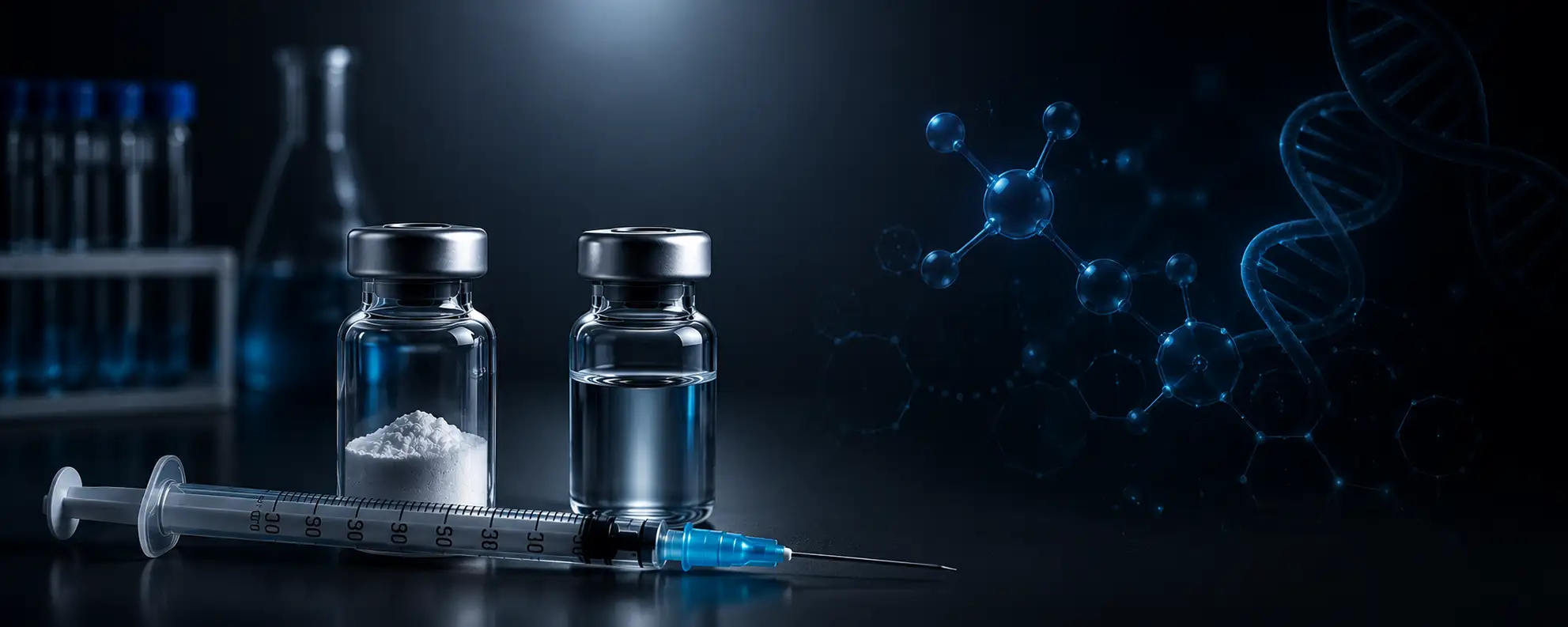
CJC-1295 with DAC is built on the same truncated GHRH(1-29) backbone as Mod GRF 1-29, but with one added feature: a Drug Affinity Complex that chemically tethers the peptide to albumin, the most abundant protein in blood plasma. That single addition is responsible for essentially every pharmacokinetic difference between the two versions of this compound.
This article breaks down what the DAC conjugation actually does, how it compares structurally and functionally to the No-DAC version and other GHRH-pathway compounds, and where the compound currently sits from a regulatory standpoint. As with any research peptide, CJC-1295 with DAC is not FDA-approved for human or animal use, and nothing here should be read as usage or dosing instructions.
What Is CJC-1295 With DAC?
CJC-1295 with DAC starts from the same molecular foundation as CJC-1295 No DAC: a 29-amino-acid fragment of human GHRH, modified at four positions to resist DPP-IV enzymatic degradation. The “with DAC” designation refers to an additional chemical modification — a Drug Affinity Complex, built from a maleimidopropionic acid (MPA) linker, attached to the peptide’s structure.
This linker was originally developed by ConjuChem Biotechnologies as a general-purpose technology for extending the functional lifespan of therapeutic peptides by binding them to serum albumin. Once bound, the peptide is shielded from rapid renal clearance and enzymatic breakdown, which is what gives CJC-1295 with DAC its signature extended activity window compared to unmodified or non-DAC GHRH fragments.
In short: CJC-1295 with DAC is CJC-1295 No DAC’s molecular backbone, plus an albumin-binding delivery mechanism layered on top.
The Drug Affinity Complex: How DAC Extends Half-Life
The DAC mechanism works through a straightforward chemical principle rather than anything exotic. The maleimide group in the linker reacts with a free cysteine residue on circulating albumin, forming a stable covalent bond between the peptide and the protein. Albumin has a naturally long half-life in the bloodstream — it’s one of the reasons the body uses it as a carrier molecule for so many other compounds — so anything covalently attached to it inherits some of that same persistence.
This is different from simple protein binding, where a drug loosely associates with albumin and can dissociate freely. A covalent DAC bond doesn’t come apart the same way, which is why the extension in half-life is so pronounced — commonly cited in industry and supplier literature as a six-to-eight-day range, compared to roughly 30 minutes for the No-DAC version.
The practical consequence: instead of a single sharp GH pulse, the sustained albumin-bound presence of the peptide is associated with a more continuous elevation in GHRH receptor activity — sometimes referred to informally in community discussion as a “GH bleed” pattern, distinct from the pulsatile release studied with No-DAC compounds.
CJC-1295 With DAC vs. No DAC: The Complete Comparison
Attribute | CJC-1295 With DAC | CJC-1295 No DAC (Mod GRF 1-29) |
|---|---|---|
Albumin binding | Covalent, via DAC/MPA linker | None |
Approximate half-life | Commonly cited 6–8 day range | ~30 minutes |
GH release pattern | Sustained, near-continuous elevation | Single pulsatile spike |
Typical research pairing | Standalone, longer-interval protocols | Ipamorelin, GHRP-6 (dual-receptor pulsatility studies) |
Molecular basis | Truncated GHRH(1-29) plus DAC conjugation | Truncated GHRH(1-29) with DPP-IV-resistant substitutions only |
Common naming | “With DAC,” “DAC:GRF” | “No DAC,” “Mod GRF 1-29” |
If a research design calls for studying the body’s natural GH pulsatility — the frequency and amplitude of discrete GH pulses — the No-DAC version is the structurally appropriate tool, since a sustained-release compound would flatten out the very pattern being studied. If the research question is instead about the physiological effects of prolonged, low-amplitude GHRH-receptor stimulation, the DAC version’s extended activity window is the relevant model. Neither version is simply “better” than the other; they answer different research questions.
Mechanism of Action and IGF-1 Elevation
Like its No-DAC counterpart, CJC-1295 with DAC activates the GHRH receptor (GHRH-R) on pituitary somatotroph cells, triggering the same cAMP/PKA intracellular signaling cascade that leads to growth hormone release. What differs is the duration and pattern of that receptor activation.
Because the DAC-bound peptide remains in circulation far longer, sustained GHRH-R activity is associated with a more prolonged downstream effect on the somatotropic axis — the GH/IGF-1 signaling pathway. Insulin-like growth factor 1 (IGF-1) is produced in the liver in response to GH signaling, and much of the research interest in the DAC version specifically relates to its extended-elevation profile within this axis. This is a mechanistic description of the pathway, not a claim about specific IGF-1 elevation magnitudes — any numeric claims about IGF-1 change should be sourced to a specific, citable study rather than presented as a general property of the compound.
CJC-1295 With DAC vs. Sermorelin vs. Ipamorelin
These three compounds are frequently compared in research discussion, but they work through genuinely different mechanisms and shouldn’t be treated as interchangeable options on a single spectrum.
Compound | Receptor Pathway | Half-Life Profile | Primary Research Distinction |
|---|---|---|---|
CJC-1295 With DAC | GHRH receptor (GHRH-R) | Extended (6–8 day range, commonly cited) | Albumin-bound; sustained rather than pulsatile activity |
Sermorelin | GHRH receptor (GHRH-R) | Very short (minutes) | Closest to native, unmodified GHRH(1-29); no DAC or DPP-IV modifications |
Ipamorelin | Ghrelin receptor (GHSR-1a) | Short | Different receptor entirely; often paired with GHRH analogs in dual-receptor research designs |
The distinction worth emphasizing here: Sermorelin and CJC-1295 with DAC both work through the GHRH receptor, but at opposite ends of the half-life spectrum, while Ipamorelin isn’t really a GHRH-pathway comparison at all — it’s a ghrelin-receptor agonist, which is why it’s more often discussed as a stacking partner than a direct substitute.
Regulatory and Compounding Status in 2026
CJC-1295, encompassing both DAC and No-DAC forms, was at one point nominated for inclusion on the FDA’s 503A Category 2 bulk substances list — the list governing which bulk substances licensed compounding pharmacies are permitted to use. As of April 2026, reporting indicated that nomination had been withdrawn, and the compound did not appear on the agenda for the July 2026 Pharmacy Compounding Advisory Committee meeting.
In plain terms: CJC-1295 with DAC is not an FDA-approved drug, is not currently authorized for 503A Category 2 compounding, and remains classified strictly as a research-use-only compound. Regulatory determinations for substances like this are subject to change, so this section should be dated and periodically reconfirmed against the FDA’s own public docket rather than treated as a permanent statement.
Editorial note: verify the current FDA docket status directly before publishing, since this can shift between report compilation and publication date.
Purity, COA Verification, and Supplier Trust
The same trust concerns that dominate discussion of the No-DAC version apply here, and if anything carry more weight given the higher price point typically associated with DAC-conjugated peptides. A meaningful certificate of analysis (COA) should show:
- HPLC purity result, as a percentage specific to the tested batch
- LC-MS identity confirmation, verifying the DAC conjugation is actually present and the molecule matches its labeled identity — not just that “a peptide” is present
- Batch or lot number matching the specific vial received
- Named third-party testing laboratory, rather than an internal-only test
- Test date, since conjugated peptides can have different stability characteristics than their unconjugated counterparts
Because the DAC conjugation is a more complex synthesis step than the base peptide alone, verifying that the conjugation itself is confirmed by LC-MS — not just an overall purity percentage — is a more specific and more useful trust signal for this particular compound than for simpler peptides.
Handling and Storage Principles
At a general level, lyophilized research peptides are typically stored frozen and shielded from light and repeated freeze-thaw cycling prior to any laboratory use, and supplier-specific storage guidance should always take precedence over generic advice. This article does not provide reconstitution ratios, volumes, or dosing protocols — those specifics depend on the intended research application and should be determined by qualified researchers using their own institutional protocols and the compound’s certificate of analysis, not a blog post.
What the Research Literature Actually Shows
The DAC conjugation technology itself originates from work at ConjuChem Biotechnologies, and it’s worth being direct about the state of the evidence: peer-reviewed literature specifically isolating CJC-1295 with DAC’s pharmacokinetics is considerably thinner than the literature on native GHRH or on approved GHRH analogs like Tesamorelin. Where a specific numeric claim — half-life duration, IGF-1 elevation magnitude, and so on — can’t be traced to a citable, verifiable source, the honest approach is to describe it as commonly reported in industry and supplier literature rather than presenting it as an established clinical finding. That distinction matters both for accuracy and for genuine E-E-A-T signal — overstating the evidence base is exactly the kind of thing that erodes trust with a research-literate audience.
Common Myths About CJC-1295 With DAC
Myth: “CJC-1295” always refers to the DAC version. Not necessarily — plenty of content uses “CJC-1295” ambiguously to mean either variant. Always check whether DAC status is specified.
Myth: The DAC version is simply a stronger dose of the same thing as No DAC. It’s not a dosing difference — it’s a structural modification that changes clearance and release pattern entirely. Sustained elevation and pulsatile release are different physiological patterns, not different intensities of the same one.
Myth: A longer half-life automatically makes the DAC version the “better” research choice. Which version is appropriate depends entirely on the research question. Pulsatility studies need the No-DAC version specifically; sustained-exposure studies are where the DAC version’s profile is relevant.
Myth: This compound has an established, well-documented clinical evidence base. The peer-reviewed literature specifically on CJC-1295 with DAC is limited relative to compounds with formal clinical trial histories. That should be stated plainly rather than implied otherwise.
Myth: DAC conjugation means the peptide is FDA-approved or clinically validated. DAC is a delivery/half-life-extension technology, not a regulatory designation. CJC-1295 with DAC remains non-FDA-approved and research-use-only regardless of the conjugation chemistry involved.
Conclusion
CJC-1295 with DAC is the extended-activity member of the CJC-1295 family — the same truncated GHRH(1-29) backbone as Mod GRF 1-29, with a Drug Affinity Complex added to bind the peptide to circulating albumin and extend its functional presence from roughly 30 minutes to a commonly cited six-to-eight-day range. That structural difference is what separates a sustained-elevation research profile from a pulsatile one, and it’s the single most important thing to understand before choosing between the two compounds for any given research design. As with the No-DAC version, the honest starting point for evaluating a supplier is a real, batch-matched, third-party certificate of analysis — not marketing language about purity.
Call-to-Action
Researchers comparing CJC-1295 with DAC against the No-DAC (Mod GRF 1-29) version should review the current certificate of analysis, confirm third-party LC-MS verification of the DAC conjugation itself, and match the compound’s release profile to the specific research design before purchasing. [Browse the CJC-1295 with DAC research peptide listing] and review the published COA before ordering.
Frequently Asked Questions
What is CJC-1295 with DAC?
CJC-1295 with DAC is a GHRH(1-29)-based peptide analog with a Drug Affinity Complex attached, which covalently binds it to serum albumin and extends its functional half-life to a commonly cited six-to-eight-day range.
What does “DAC” stand for in CJC-1295?
DAC stands for Drug Affinity Complex — a maleimidopropionic acid linker technology originally developed by ConjuChem Biotechnologies to extend peptide half-life via albumin binding.
How is CJC-1295 with DAC different from CJC-1295 No DAC?
The No-DAC version (Mod GRF 1-29) has no albumin-binding conjugate, clears in roughly 30 minutes, and produces a single pulsatile GH release. The DAC version binds albumin, lasts days rather than minutes, and produces a sustained rather than pulsatile elevation.
How does the Drug Affinity Complex extend half-life?
The DAC linker forms a covalent bond with a cysteine residue on circulating albumin. Because albumin itself has a long half-life, the attached peptide is shielded from rapid clearance and degradation.
What is the half-life of CJC-1295 with DAC?
Industry and supplier literature commonly cites a range of roughly six to eight days, though exact figures can vary by source and should be confirmed against a specific citable reference where possible.
Does CJC-1295 with DAC elevate IGF-1?
The compound’s mechanism — sustained GHRH-receptor activation — is mechanistically linked to the GH/IGF-1 signaling axis, but specific IGF-1 elevation figures should be sourced to a verifiable study rather than stated as a general property.
How is CJC-1295 with DAC different from Sermorelin?
Both work through the GHRH receptor, but Sermorelin is an unmodified, short-half-life fragment, while CJC-1295 with DAC’s albumin conjugation extends its activity window dramatically by comparison.
How is CJC-1295 with DAC different from Ipamorelin?
Ipamorelin activates a different receptor entirely — the ghrelin receptor (GHSR-1a) — rather than the GHRH receptor, so the two compounds aren’t direct substitutes; they’re more commonly discussed as complementary in dual-receptor research designs.
Is CJC-1295 with DAC FDA approved?
No. CJC-1295, in either DAC or No-DAC form, is not FDA-approved for human or animal use and is classified strictly as research-use-only.
What is CJC-1295’s current FDA compounding status in 2026?
CJC-1295’s nomination to the FDA’s 503A Category 2 bulk substances list was reported withdrawn as of April 2026 and did not appear on the July 2026 Pharmacy Compounding Advisory Committee agenda. Confirm current status against the FDA’s public docket, since this can change.
Is there strong clinical trial data on CJC-1295 with DAC specifically?
Peer-reviewed literature specifically isolating this compound is more limited than for compounds with a formal clinical trial history. That gap should be acknowledged directly rather than implied to be more robust than it is.
How do I know if a CJC-1295 with DAC supplier is legitimate?
Look for a batch-matched certificate of analysis from a named third-party lab showing both HPLC purity and LC-MS confirmation that the DAC conjugation is actually present — not just an overall purity percentage.
What does “GH bleed” mean in relation to CJC-1295 with DAC?
It’s an informal term used in community and supplier discussion to describe the sustained, near-continuous elevation in GH-axis activity associated with the DAC version’s extended half-life, as opposed to a discrete pulsatile spike.
Can CJC-1295 with DAC be used together with CJC-1295 No DAC in the same research design?
Some research designs may compare or combine the two to study different aspects of GH release, but this is a research-design decision that depends entirely on the specific study’s objectives, not a general recommendation.
Why do some suppliers use “CJC-1295” without specifying DAC status?
It’s a common source of confusion across the industry. A well-documented product page should always specify whether it’s referring to the DAC or No-DAC variant, since the two have meaningfully different pharmacokinetics.